
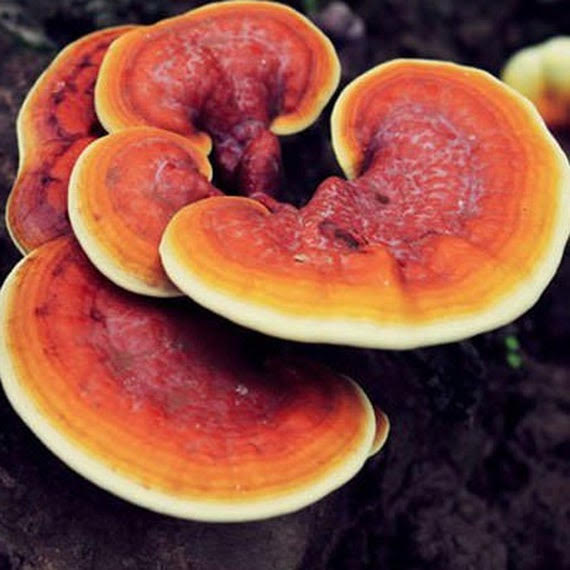
Focusing on our friend the Reishi Mushroom
Mushrooms have been used for centuries in ancient cultures for medicinal uses. These fancy fungi are also tasty and amazing superfood. It has not been until recently, especially now with so many people starting to become more involved in their own health, that people are starting to discover for themselves the wonderful properties of mushrooms. There has been a big public interest in their use and they have gained great popularity. You can not only find them in your produce section to make in your recipes, but also in many health food stores and in many products and forms for supplementation. Mushrooms, believe it or not, are great for their nutritional value. They are one of the non-meat sources of B vitamins. They also contain fiber and other key nutrients such vitamin D2, protein, calcium, magnesium, potassium, selenium, copper and iron just to name a few. These nutrients alone can help your body properly manage cholesterol, insulin response, tissue growth, concentration and energy production. The composition of mushrooms helps promote physical and mental wellbeing.
There are many different species of mushrooms all with their own health and medicinal properties. Chaga is a great mushroom that can help support the immune system and also has phenomenal antioxidant properties. Lion’s Mane has properties that can support your brain and nervous system ultimately helping with cognition, memory and concentration. Cordyceps can help with energy and fatigue by helping your body promote its own cellular energy production. Maitake may aid in cancer recovery by starving and slowing tumor growth inhibiting cancer cells ability to grow blood vessels for survival, can help with chemotherapy side effects and even promote detoxification helping the burden of the liver with chemotherapy treatment. It would take entirely too long to break down all the great species of mushrooms and what wonderful properties they have so, the focus of this piece will be the ever so popular Reishi mushroom…so let’s get to it.
The Reishi mushroom, Ganoderma lucidum, and also known as the lingzhi mushroom has been known in Asian countries to promote health and longevity. In these culture’s the mushroom has been used more for its pharmaceutical properties than for its nutritional value. There are many species of Ganoderma that grow all over the world the most popular being black and red. The growth in popularity and recognition of these mushrooms medicinal properties has promoted many in vitro and animal studies, yet human studies are lacking due to limits in control population and quality and variation of the plant itself. With that being said there is a reason this powerful fungus has been used by people for thousands of years for its benefits on health. Let us take a look at the science behind this powerful saprophyte (it would be offensive to call it a plant).
Most mushrooms contain mainly water and only about 10% of them are made of proteins, fat, carbohydrates, fiber and of course vitamins and minerals. This is why dehydrating them and forming powders gives you the most nutrient dense form. The protein content in mushrooms contains all the essential amino acids (your building blocks), the fat is mainly polyunsaturated (the good kind) and of course fiber is fantastic for you as well. This is why alone they are considered a super food. The Reishi mushroom’s growth and popularity are due to some of its studied constituents and their physiological activity. These 3 components are polysaccharides, peptidoglycans and triterpenes. Let break down each of these.
Polysaccharides are a class of carbohydrate that help humans maintain energy, immune, digestive and detoxification functions to name a few. Important and healthy carbohydrates are resistant starches (fiber) which can be found in mushrooms and a variety of other sources. Resistant starches play a critical role in digestion and overall health. Having these in your diet can help decrease risks of many chronic diseases including cardiovascular disease and are very important in cancer prevention. Resistant starches are called low glycemic index (GI) foods. These help to slow digestion, reduce spikes in glucose levels, ultimately leading to better metabolic control and decreased risk of long-term health consequences like diabetes and cardiovascular issues. Polysaccharides also make up the components of plant cell walls. These structures can stimulate your bodies own immune response in turn helping to build immune cells, thus strengthening your immunity and immune function.
Peptidoglycans are found in the cell walls of bacteria and some mushroom species such as the Reishi mushroom. In fact, most antibiotic drugs, such as penicillin, target the building or breakdown of bacterial cell walls to cause the bacterial cells to die. These particular molecules whole or broken down can help stimulate the innate immune response in humans and therefore making it stronger. Peptidoglycans can also be broken down and used by other bacteria, like the healthy bacteria in your gut, to send signaling to other bacteria regarding threatening bacteria or collection of nutrients for bacterial growth.
The Reishi mushroom is rich in triterpenes which help to contribute to its health benefits. Triterpenes alone are potent antioxidants, which are important in eliminating oxidative stressors in the body. There has been some promise that triterpenes are cytotoxic against tumor cells and this is why they have been highly used for natural and preventative treatment in cancer. Triterpenes give the Reishi mushroom its bitter taste. In ancient Chinese Medicine bitter taste in herbs and plants indicates the promotion of liver detoxification and nervous system support. Triterpenes have also been studied for their anti-viral properties helping to inhibit replication.
Besides containing key components, nutrients, minerals and vitamins the Reishi mushroom is also a powerful antioxidant, can be considered an anti-inflammatory, antibacterial, antiviral and hepatoprotective. There is a reason that it has been given the reputation of being a “longevity” mushroom. The Reishi is well known for its promising antitumor properties, maintaining level blood glucose and cholesterol. With all these health benefits it would be stupid not to consider this fungus a major superfood. So, if you want to incorporate a natural and ancient way to keep you living a happy and healthy life I would consider giving the Reishi mushroom a chance.
Resources Used:
Wachtel-Galor, S., Yuen, J., Buswell, J., Benzie, I., Herbal Medicine: Biomolecular and Clinical Aspects 2nd Edition, Boca Raton (FL) CRC
Press/Taylor & Francis: 2011
Zhang, J., Li, Y., Zhou, T., Xu, D., Zhang, P., Li, S., Li, H., et al. (2016) Bioactivities and Health Benefits of Mushrooms Mainly from China,
Molecules, Jul; 21(7): 938.
Irazoki, O., Hernandez, S., Cava, P., et al. (2019) Peptidoglycan Muropeptides: Release, Perception, and Functions as Signaling Molecules,
Front. Microbiol., 28 March
https://www.ncbi.nlm.nih.gov/pmc/articles/PMC5152545/
 Integrative Health Coaching